

A new generation of wind turbines
EcoWind
The EFRO-funded EcoWind project is developing wind turbine technology that lasts longer, uses fewer materials and is easier and more affordable to maintain. Through innovations in rotor blades, control systems and turbine design, the project aims to help create a new generation of lightweight, powerful wind turbines. At the same time, through EcoWind, we aim to strengthen collaboration between regional companies and knowledge institutions, bringing together complementary expertise to accelerate innovation in the wind energy sector. Together with We4Ce Engineering, Suzlon Blade Technology and the University of Twente, we combine our expertise and work towards turning these ambitions into practical solutions.
A new generation of wind turbines depends on more than one innovation. The EcoWind partners are developing solutions for rotor blades and turbine control, while working towards a lighter, high-capacity turbine design. As a project partner, 2-B Energy contributes to this shared ambition: bringing these innovations together in a turbine concept designed to generate more energy with fewer resources.
A rotor blade with a replaceable tip
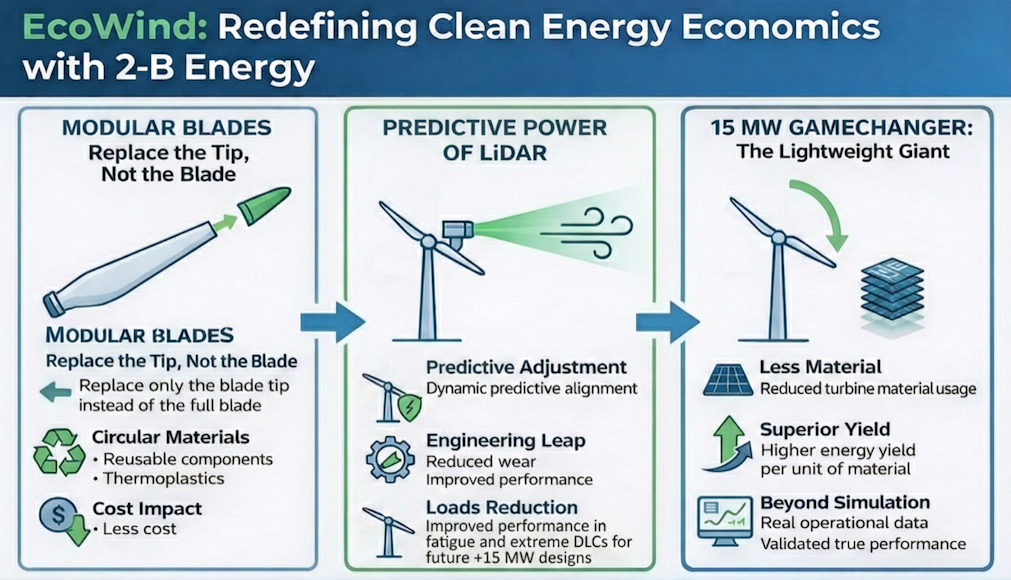
In conventional wind turbine designs, damage to a rotor blade can mean replacing the entire blade, which is a costly exercise. EcoWind is developing a rotor blade with a replaceable tip, which could make repairs easier while reducing material use and costs.
The project is also investigating whether the blade tip can be made from thermoplastic material, which can be recycled. This could provide an alternative to conventional thermoset composites, which are difficult to reuse.
Smarter turbine control with LiDAR
EcoWind is exploring how LiDAR can make wind turbine control smarter. LiDAR uses laser beams to measure the wind ahead of the turbine, helping the system detect approaching wind and gusts earlier. Using this information, the turbine can adjust its blades before the wind reaches the rotor. This helps distribute loads more evenly and reduce stress on the turbine. It could also reduce wear and extend the turbine’s service life while maintaining optimal energy output.
A lightweight turbine rated at 15 MW+
The replaceable blade tip and LiDAR-based control are part of the project’s ambition to develop a new generation of wind turbines rated at more than 15 MW. By combining these innovations, the project aims to reduce the turbine’s material use by around 20% and the tower’s material use by 15%. Rotor blades that last longer could also mean fewer replacements and less waste. The ultimate goal is to bring circular wind turbine technology to market: technology that generates renewable energy using fewer resources, producing less waste and enabling more materials to be reused.